


The role in the organization : clarifying tasks and objectives
Posté le

The role of every worker, regardless of their position in the hierarchy, has a decisive impact on the organization. Recognizing the contribution of each employee supports both the company’s growth and the well-being of its workforce, thereby enhancing overall productivity. This is why managers play a key intermediary role between employees and leadership.
Clarity of objectives and responsibilities
Clarity of objectives and responsibilities is essential for defining roles within the organization.
However, this role can sometimes be challenging for managers. This is often because many of them have not previously performed the tasks of the employees they supervise. This is why communication and active listening play a decisive role in the smooth functioning of an organization.
It is also important that objectives are negotiated rather than imposed. This should take the form of an open discussion between the manager and team members to define goals that are both necessary and achievable. In this way, the outcome is agreed upon and validated by all parties involved.
Assign specific tasks to each individual
Companies often set significant objectives, sometimes overly ambitious, whether in the short or long term. It can therefore be beneficial to adopt proven management methods in order to provide employees with clear and well-defined tasks.
The SMART method

This is a fairly common objective-based management method, according to which each of your objectives must have these five characteristics.
Using this method will allow you not only to adopt an effective strategy for the realization of your projects, but also to detail precisely its objectives.
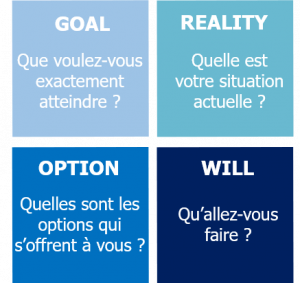
This model is based on four essential questions to apply to team or project management. Simple and adaptable, this method can save considerable time when implementing your managerial practices.
The GROW model
These methods provide valuable guidance for implementing your projects and objectives. However, to ensure both team effectiveness and well-being, it is also important to establish proper follow-up. First, recognizing and congratulating your teams when objectives are achieved is essential. Then, ongoing monitoring allows you to track project progress and adjust goals to each individual. If certain objectives have been achieved easily, it may be relevant to set more challenging tasks next time. Conversely, if difficulties arise, it is important to identify their causes and implement solutions to make future outcomes more attainable.
Ambiguity of the objectives set
For a project to be successfully carried out, it is essential that objectives are clear and unambiguous. If employees do not fully understand the context and expected outcomes of the tasks assigned to them, it becomes much more difficult for them to complete them effectively.
To achieve this, managers should work with their employees to develop clearly defined action plans. Setting large individual goals can often feel overwhelming. To address this, managers should break down macro-objectives (those of the organization) into micro-objectives (those of employees), which can then be further divided into smaller tasks. This approach provides employees with a clear overall vision while making each task more manageable and achievable.

Table des matières

Les actualités RH de Balencio directement dans votre boîte mail
