


PAPRIPACT: everything you need to know about the annual occupational risk prevention programme
Posted on

Key takeaways:
- The PAPRIPACT (programme annuel de prévention des risques professionnels et d’amélioration des conditions de travail), the French annual programme for preventing occupational risks and improving working conditions, is mandatory in companies with at least 50 employees. It derives from the DUERP (Article L4121-3-1 of the French Labour Code).
- It sets out the detailed list of measures for the coming year with, for each one, its implementation conditions, outcome indicators and estimated cost. It identifies the available resources and includes a timetable.
- Below 50 employees, there is no annual programme: prevention actions are listed in the DUERP and its updates.
- Every year, the employer presents an annual report (review of the past year) and the programme to the CSE (social and economic committee), as part of the consultation on social policy (Article L2312-27). The CSE gives an opinion and may propose an order of priority and additional measures.
- If measures planned or requested by the CSE have not been carried out, the employer explains why in an appendix to the annual report. The minutes of the meeting must be attached to any application for public contracts, subsidies or tax benefits.
Manage your prevention actions, your indicators and your teams’ feedback in one place: discover the Balencio platform.
Balencio complements your prevention approach; it replaces neither your DUERP nor your annual programme.
What is the PAPRIPACT?
The PAPRIPACT is the employer’s annual action plan for health, safety and working conditions. It turns the results of the risk assessment into concrete, costed and scheduled measures.
Definition of the annual prevention programme
The annual programme for preventing occupational risks and improving working conditions, often abbreviated to PAPRIPACT, is defined in Article L4121-3-1 of the Labour Code. The Code does not use this acronym: it is common usage, adopted in particular by the French Ministry of Labour.
According to Article L4121-3-1, the annual programme:
- Sets out the detailed list of measures to be taken during the coming year, including measures to prevent the effects of exposure to occupational risk factors
- Specifies, for each measure, its implementation conditions, outcome indicators and estimated cost
- Identifies the company resources that can be mobilised
- Includes an implementation timetable
Regulatory note
The annual programme is mandatory in companies with 50 or more employees. Below that, the employer defines prevention and protection actions, recorded in the DUERP.
Link between the PAPRIPACT and the DUERP
The DUERP is the diagnosis: it lists risks by work unit. The PAPRIPACT is the action plan: it decides what the company will do this year to reduce them. Article L4121-3-1 provides that the results of the risk assessment “lead to” this programme.
The two documents form a loop that repeats every year:

Legal framework and the Labour Code
Several articles of the Labour Code govern the annual programme:
- L4121-1 and L4121-2: general safety obligation and general principles of prevention
- L4121-3: risk assessment. The CSE contributes to the assessment and is consulted on the DUERP and its updates
- L4121-3-1, III: content of the annual programme (from 50 employees) or list of actions (fewer than 50 employees). Paragraph IV provides that sector bodies may support companies
- L2312-27: presentation of the annual report and the programme to the CSE, opinion, additional measures, reasons for non-implementation, minutes
- R2312-6: CSE consultation deadlines in the absence of an agreement
These provisions have applied since 31 March 2022, when the Act of 2 August 2021 to strengthen occupational health prevention came into force.
Point of attention
The administrative fine introduced in 2026 targets the absence of a DUERP (paragraphs I and II of Article L4121-3-1). It does not cover the annual programme, provided for in paragraph III. This does not exempt you from drawing it up: failing to consult the CSE may in particular constitute the offence of obstruction (délit d’entrave).
Who is concerned by the PAPRIPACT?
The criterion is the company’s headcount. The table below summarises the obligations by size:
| Obligation | Fewer than 11 employees | 11 to 49 employees | 50 employees or more |
|---|---|---|---|
| DUERP | Mandatory from the first employee | Mandatory | Mandatory |
| DUERP update | At each major change or new information. No annual obligation | At least once a year, and at each event | At least once a year, and at each event |
| Prevention actions | List of actions recorded in the DUERP | List of actions recorded in the DUERP | Annual programme (PAPRIPACT): measures, implementation conditions, indicators, cost, resources, timetable |
| CSE | No mandatory CSE | CSE consulted on the DUERP and its updates | CSE consulted on the DUERP, the annual report and the annual programme |
| Annual health, safety and working conditions report | No | No | Yes, presented to the CSE with the programme |
| CSSCT | No | No | Mandatory from 300 employees |
Companies with fewer than 50 employees
Below 50 employees, the annual programme is not mandatory. The employer defines actions to prevent risks and protect employees, and the list of these actions is recorded in the DUERP and its updates (Article L4121-3-1, III, 2°).
Companies with 11 to 49 employees have a CSE, which is consulted on the DUERP and its updates. The annual consultation on the report and the programme (Article L2312-27) only applies from 50 employees.
- Keep a simple list of actions, with an owner and a deadline for each
- Review this list at each DUERP update
- Make use of the tools and support offered by your professional sector and your occupational health and prevention service
Good practice
Even without an obligation, structuring your list of actions like an annual programme (indicators, cost, timetable) makes it easier to cross the 50-employee threshold.
Companies with 50 employees or more
From 50 employees, the employer must draw up the annual prevention programme and present it to the CSE every year together with a written annual report. The obligations can be summarised as follows:
- Assess risks and keep the DUERP up to date
- Draw up an annual programme with the elements required by Article L4121-3-1
- Write an annual report reviewing the general health, safety and working conditions situation and the actions carried out during the past year
- Present these two documents to the CSE as part of the consultation on social policy
- Justify, in an appendix to the report, any measures planned or requested by the CSE that were not carried out
Key figures
- In 2019, 82.6% of establishments with 50 to 249 employees, 90.9% of those with 250 to 499 employees and 92.8% of those with 500 or more had drawn up or updated their DUERP during the year (Dares, self-reported survey cited by IGAS).
- 549,614 occupational accidents leading to sick leave or permanent incapacity in 2024, including 764 deaths (French national health insurance, 2024 report).
- To our knowledge, no public statistics measure the share of companies that have an annual prevention programme.
Good to know
The 50-employee threshold is assessed according to the Labour Code’s headcount rules. Check them if your company is approaching this threshold.
Role of the CSE in the PAPRIPACT
The CSE does not draft the programme: it is consulted. It gives an opinion and, on that occasion, may propose an order of priority and the adoption of additional measures (Article L2312-27).
- It contributes to the risk assessment and is consulted on the DUERP and its updates (L4121-3)
- It checks whether the risks in the DUERP are included in the programme
- It gives an opinion on the annual report and the programme
- It may propose priorities and additional measures
- Where it exists (from 300 employees), the CSSCT may prepare the work, but the opinion is given by the CSE
The CSE’s opinion is advisory: the employer is not bound by it. However, the employer must give reasons for the follow-up given to the committee’s opinions and wishes (Article L2312-15).
What must the annual prevention programme contain?
The Labour Code sets minimum content. The following table summarises it, with illustrative examples:
| Element | What the Code requires | <strong>Illustrative example</strong> |
|---|---|---|
| Detailed list of measures | Measures to be taken during the coming year, including those that prevent the effects of exposure to occupational risk factors | Replace vibrating tools, redesign a handling workstation |
| Implementation conditions | Specified for each measure | Owner, scope, resources, stages |
| Outcome indicators | Set for each measure | Number of workstations redesigned, change in sick leave linked to MSDs |
| Cost estimate | Costed for each measure | Equipment, training, replacement time |
| Available resources | Company resources identified | Budget, internal skills, support from the occupational health and prevention service |
| Timetable | Implementation timetable | Quarterly deadlines |
Occupational risk prevention actions
Actions follow the order of the general principles of prevention: avoid the risk, assess those that cannot be avoided, tackle them at source, give priority to collective over individual protection, then inform and train. Depending on your risks, the programme may include:
- Eliminating or reducing risks at source (equipment, processes, substances)
- Redesigning workstations and workplaces
- Collective protection and, failing that, personal protective equipment
- Training and informing employees and managers
- Preventing the effects of exposure to occupational risk factors (physical constraints, aggressive environment, work patterns)
Risks linked to work organisation fall under the same programme. Psychosocial risk prevention is included on the same footing as physical risks: regulating workload, managerial support, dealing with harassment and sexist behaviour, as provided for in Article L4121-2.
Illustrative example
Risk identified in the DUERP: manual handling of heavy assemblies in the workshop. Measure: buy two handling trolleys. Indicator: number of manual handling operations eliminated and sick leave linked to musculoskeletal disorders. Deadline: September.
Measures to improve working conditions
The programme is not just a safety plan: its title includes improving working conditions. The Code requires, among other things, adapting work to the individual, limiting monotonous and machine-paced work, and planning prevention by integrating work organisation, working conditions and social relations.
- Work organisation: schedules, workload, interruptions, peak periods
- Layout of workstations, premises and equipment
- Predictable working hours and work-life balance
- Management and working relationships
- Regulating the use of digital tools and the right to disconnect
The right to disconnect is part of the annual negotiation on workplace equality and quality of working life in companies with union sections. In the absence of an agreement, the employer draws up a charter after consulting the CSE (Article L2242-17, 7°). These measures can be included in the annual programme for consistency.
List of actions carried out and to be carried out
The programme covers the actions to be carried out during the coming year. Actions carried out the previous year appear in the annual report, which reviews them. If measures planned or requested by the CSE were not taken, the employer sets out the reasons in an appendix to this report.
A single table makes monitoring easier. Here is a standard structure, with two example rows using fictitious values:
| Risk (DUERP ref.) | Measure and owner | Estimated cost and resources | Outcome indicator | Deadline and status |
|---|---|---|---|---|
| Manual handling, workshop | Purchase of two trolleys. Owner: workshop manager | €8,000 (fictitious). Investment budget, support from the prevention service | Manual handling operations eliminated, sick leave linked to MSDs | September. In progress |
| Workload, customer service | Review schedules and peak periods. Owner: HR | Working group time, no direct cost | Gap between perceived and planned workload | June. To be launched |
An HR dashboard brings this information together with your other data (absences, accidents, headcount) and gives HR teams, managers and management an overview.
Allocated means and resources
The programme identifies the company resources that can be mobilised, and each measure is costed. Think about both direct and indirect costs:
- Budget: equipment, works, training, services
- Time: preparation, training, replacing absent employees
- Internal skills: designated competent employee, HR, managers, CSE
- External support: occupational health and prevention service, sector bodies (Article L4121-3-1, IV), Carsat
- Tools: tracking tables, management and listening platform
How to draw up and structure your PAPRIPACT
The law does not prescribe a method. The following seven-step approach is the most common:

Analysing the risks identified in the DUERP
The starting point is the DUERP. Reread it with an action-oriented eye:
- Which risks are not yet under control?
- Which risks have appeared since the last update (accidents, reports, reorganisations)?
- Which of last year’s actions were not carried out?
- What do the CSE and the occupational health and prevention service say?
Do not forget psychosocial risks (PSR): a global analysis, by work unit, avoids dealing with them case by case.
Prioritising prevention actions
You will not be able to tackle everything in a year. Rank actions according to several criteria:
- The severity of the possible consequences
- The number of employees exposed and the duration of exposure
- The current level of control of the risk
- Feasibility (cost, time, available skills)
- CSE proposals and regulatory obligations
Risks linked to workload are prioritised like the others: scale, number of employees concerned, effects on health. A priority matrix, such as the one offered by Balencio, helps decide where to act first based on how teams feel.
Good practice
Ten realistic, monitored measures are better than forty measures without resources. An over-ambitious programme ends in a long list of non-implemented measures to justify to the CSE.
Planning and implementation timetable
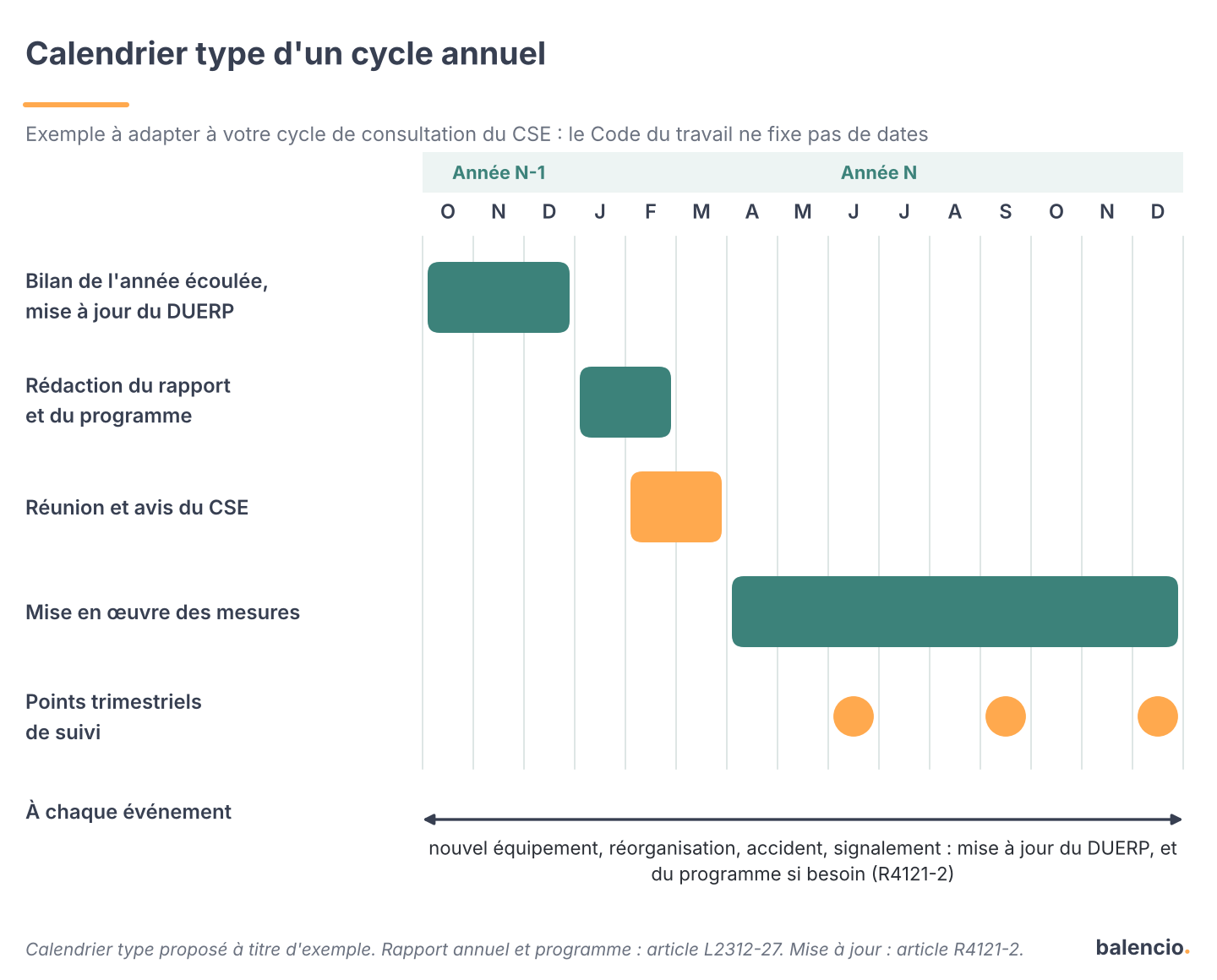
The Code does not set dates, but requires an implementation timetable. Here is a typical timetable over the year, to be adapted to your CSE consultation cycle:
Budget and necessary resources
Each measure in the programme comes with a cost estimate. Proceed in three stages:
- Cost each measure (direct costs and time spent)
- Add them up, then make trade-offs based on priorities and the available budget
- Identify possible support: sector bodies, occupational health and prevention service, Carsat
Good to know
The detailed, costed programme is not just an internal document: the minutes of the CSE meeting that examines it must be attached to applications for public contracts, subsidies, grants or social or tax benefits (Article L2312-27).
Consulting the CSE and presenting the PAPRIPACT
The presentation to the CSE is the key step in the annual cycle. It is governed by the Labour Code.
Obligation to consult the social and economic committee
In companies with at least 50 employees, the employer presents a written annual report and the annual prevention programme to the CSE as part of the consultation on social policy (Article L2312-27). The CSE gives an opinion on these documents.
Regulatory note
The minutes of the CSE meeting devoted to examining the report and the programme are attached to any application by the employer for public contracts, public funding, subsidies, grants of any kind or social or tax benefits.
If the employer does not consult the CSE, or consults it improperly, it is exposed in particular to the offence of obstruction and to being unable to produce the minutes required for these applications.
How to present the programme
For the CSE to give an informed opinion, the employer provides or makes available precise, written information and allows enough time for review. Prepare:
- The written annual report: a review of the general health, safety and working conditions situation and of the actions carried out. Night work and the prevention of the effects of exposure to occupational risk factors are covered specifically
- The appendix setting out the reasons why measures were not carried out
- The annual programme, in the form of a clear table, with indicators, costs and timetable
- The up-to-date DUERP, so the CSE can check that the identified risks are being addressed
Schedule a meeting dedicated to examining the report and the programme: this is what gives rise to the minutes required by the Code. Where it exists, the CSSCT can prepare the content with the employer.
Consultation deadlines and frequency
The consultation on social policy is annual. In the absence of an agreement, the deadlines in Article R2312-6 apply:
- One month to give the opinion
- Two months if an expert is involved
- Three months if expert reports are commissioned in a consultation conducted at both central CSE and establishment committee level
After this deadline, the CSE is deemed to have been consulted and to have given a negative opinion.
Good to know
A company agreement may set the number of CSE meetings, the deadlines for opinions and the frequency of consultations, which may not exceed three years (Article L2312-19). Check the terms of your agreement, bearing in mind that the programme covers the coming year.
Monitoring and evaluating the annual prevention programme
A programme that is not monitored becomes a list of intentions. Monitoring also helps prepare the annual review and feed into the DUERP update.
Action monitoring indicators
The Code requires outcome indicators for each measure. Combine several types of indicators, including QWL indicators:
| Type | Examples | Recommended frequency |
|---|---|---|
| Implementation | Share of actions completed on time, budget used | Quarterly |
| Outcome | Accidents and near misses, occupational diseases, sick leave, exposure to risk factors | Quarterly or half-yearly |
| Perception | Perceived workload, stress, team climate, trust in management | Quarterly (short surveys) or annually |
| Social dialogue | Follow-up given to CSE opinions, additional measures adopted | Annually |
Good practice
An indicator must be measurable with the data you have. Four indicators tracked every quarter are better than fifteen that are never updated.
Annual review of the measures implemented
The written annual report reviews the past year. It is the counterpart of the programme and prepares the next consultation. To make it useful, check that it covers:
- The actions carried out, with their actual cost and results
- The actions not carried out, with the reasons in an appendix
- Night work and the prevention of the effects of exposure to occupational risk factors
- Lessons for the DUERP update and the next programme
Complement the figures with how teams feel. An annual social barometer measures changes in how people feel about workload, management or climate, and lets you check that the measures taken are perceived as effective.
Adjustments and continuous improvement
The programme is a living document. During the year, several events justify reviewing it: an accident, a report, a reorganisation, new equipment. Depending on the case, they also trigger a DUERP update (Article R4121-2).
- Hold a quarterly review with the CSE or the CSSCT
- Incorporate CSE proposals and feedback from managers
- Reallocate resources from abandoned measures to new priorities
- Document each adjustment and the reason for it
A culture of feedback makes this loop easier: teams and managers flag early what is and is not working, so you can adjust before the end of the year.
Track your prevention indicators and your teams’ feedback throughout the year: discover the Balencio platform.
Real-time results, trends over time and HR action plans in one place.
Frequently asked questions about the PAPRIPACT
What is the difference between the DUERP and the PAPRIPACT?
The DUERP is a diagnosis. It lists occupational risks by work unit, in all companies from the first employee.
The PAPRIPACT is an action plan. It sets out the measures for the coming year to address these risks and improve working conditions, with indicators, cost, resources and a timetable. It is mandatory from 50 employees. Below that, the list of prevention actions is recorded in the DUERP.
Is the PAPRIPACT mandatory for all companies?
No. It is mandatory in companies with 50 or more employees. Below this threshold, the employer defines prevention actions, listed in the DUERP.
To our knowledge, the Labour Code does not provide for a specific penalty for not having an annual programme. The 2026 administrative fine targets the absence of a DUERP, not the programme. However, failing to consult the CSE may constitute the offence of obstruction, and a lack of prevention actions may engage the employer’s liability in the event of an accident.
Who should draft the annual prevention programme?
The obligation lies with the employer, who can rely on several contributors:
- HR and health, safety and working conditions managers
- The competent employee designated for protection and prevention, if there is one
- The occupational health and prevention service, which contributes to the risk assessment
- Managers and employees, who know the real work
- Sector bodies, which can support companies
The CSE is consulted: it gives an opinion and may propose priorities and additional measures, but does not draft the programme.
How often should the PAPRIPACT be updated?
The programme covers the coming year, so it is drawn up and presented to the CSE every year. During the year, a DUERP update (new equipment, reorganisation, accident, new information on a risk) may lead to it being revised.
Good practice is to review the programme at each DUERP update and to hold a follow-up meeting every quarter.
Sources cited: French Labour Code, Articles L4121-1 to L4121-3-1 (Légifrance, version of 28 April 2026); Article L2312-27 (code.travail.gouv.fr, updated 31 March 2022); Articles R2312-6, L8115-1 (updated 27 June 2026), L2312-15 and L2312-19 (via code.travail.gouv.fr and OPPBTP); Article L2242-17 (via INRS); French Ministry of Labour, CSE responsibilities in health, safety and working conditions (use of the acronym PAPRIPACT); IGAS, report No. 2022-109R, May 2023 (DUERP completion rate, Dares 2019); Assurance Maladie – Risques professionnels, 2024 annual report (via Vie-publique). The examples, the typical timetable, the recommended indicators and the seven-step method are editorial recommendations.
Structure your prevention approach with a platform designed to measure, analyse and act: request a Balencio demo.
Table of content
