


Understanding and applying the eNPS : a key tool for measuring employee engagement
Posté le

In a context where human capital has become a strategic lever, more and more companies are seeking to assess employee satisfaction in a concrete way. Among the HR tools gaining popularity is the eNPS, or Employee Net Promoter Score. Easy to implement, this HR indicator provides a clear view of employees’ willingness to recommend their company. However, fully leveraging the eNPS survey requires mastering its methodology, interpretation, and integration into a broader employee engagement measurement approach. Here is how you can optimize your use of eNPS.
What is the eNPS and why take this step ?
The eNPS is based on a simple question: “Would you recommend our company as a place to work to those around you?” This approach is directly inspired by the Net Promoter Score, which has long been used in customer contexts to assess loyalty. Its adaptation to the HR field makes it possible to quickly gauge employee engagement and their level of satisfaction with company culture, management, and the overall employee experience.
Used regularly through pulse surveys, this concise barometer helps HR directors take the organization’s pulse. It stands out for its simplicity, its rapid analysis, and its ability to unite teams around a common goal: improving employees’ willingness to recommend the company, which serves as a powerful recruitment lever through word-of-mouth.
How does the calculation of the eNPS work ?
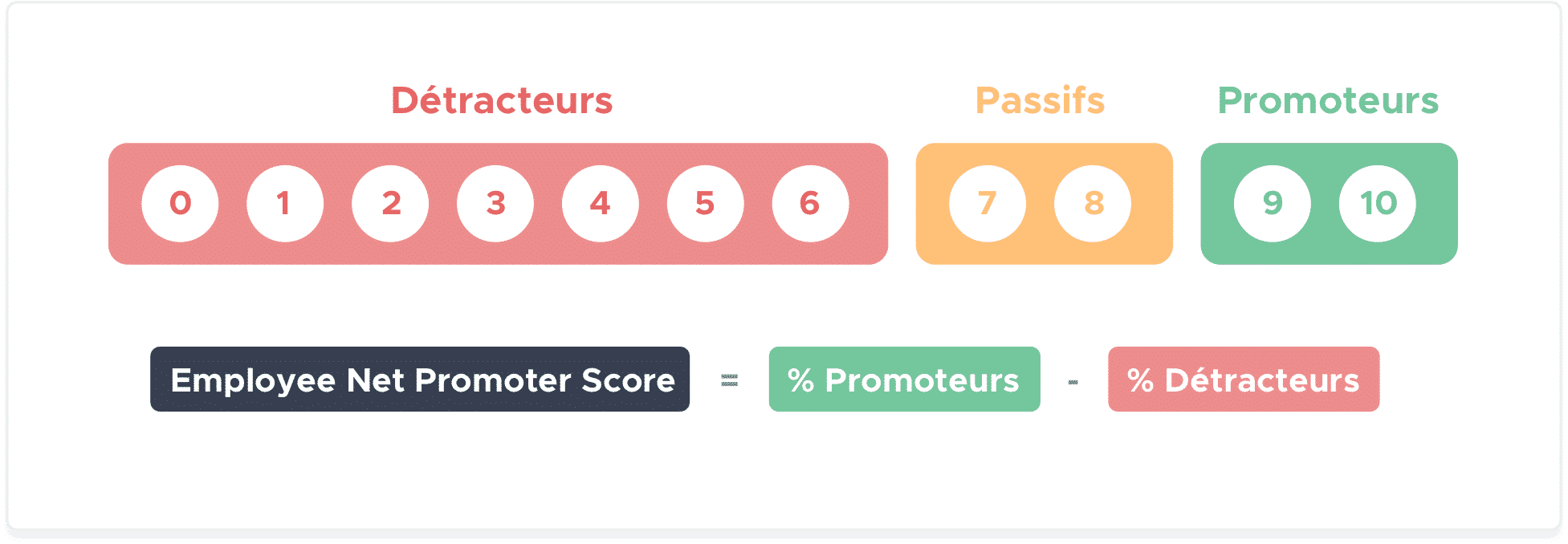
The eNPS calculation method is one of the key strengths of this system. Each participant answers the core question on a scale from 0 to 10. Responses are then segmented into three categories:
- Promoters (notes 9-10) : enthusiastic employees, proud of their company, bearers of the employer brand.
- Passive (notes 7-8) : employees are satisfied but not inclined to actively recommend their organization.
- Detractors (scores 0-6) : dissatisfied people, likely to dissuade future candidates.
The final score is calculated by subtracting the percentage of detractors from the percentage of promoters, expressed as a percentage. This result, known as the Employee Net Promoter Score, typically ranges from -100 to +100. A positive score indicates a majority of employee ambassadors, while a negative score calls for a closer examination of workplace quality or the sense of belonging within the team.
Which levels to decrypt the HR indicator ?
To effectively leverage the results, it is important to establish a sectoral or internal benchmark. Many companies observe an average eNPS ranging from 10 to 30. A score between 50 and 70 reflects strong employee loyalty, which is rare but achievable through a differentiated employee experience. Conversely, a score below zero signals a deeper organizational issue that may accelerate turnover.
The creation of comparative dashboards across teams, entities, or time periods makes it possible to visualize how employee satisfaction evolves over time. This approach provides HR managers with a valuable management tool to prioritize continuous improvement initiatives.
Why include qualitative feedback in your eNPS survey ?
While the overall score facilitates comparison, it is not sufficient to explain the underlying drivers of engagement or disengagement. Adding one or two open-ended questions to the eNPS survey encourages employees to share their feelings, suggestions, or specific needs. These qualitative insights enrich the statistical interpretation and help guide action plans toward areas that are truly expected on the ground: working conditions, recognition, professional development, and managerial relationships.
Several companies have observed a clear improvement in their Employee Net Promoter Score after adjusting their HR policies based on this open feedback. This highlights the virtuous synergy between active listening, quantitative measurement, and day-to-day employee engagement.
How to effectively launch an eNPS survey ?
Launching an eNPS survey requires establishing a transparent and reassuring framework to encourage participation. Briefly explaining the purpose of the approach, guaranteeing anonymity, and communicating the timeline for sharing results help strengthen trust. Clear and repeated communication, tailored to the different levels of the organization, maximizes response rates and encourages every employee to express themselves freely.
It is also important to involve managers from the outset. Their engagement in promoting the survey and supporting the post-survey process helps ensure ownership of the results and prevents counterproductive dynamics such as “blame culture.” Managers thus become key actors in the social climate and drivers of employee engagement.
Which tools should be chosen to structure the measurement of engagement ?
Many HR solutions now offer automated pulse survey modules that include eNPS. These platforms often allow the HR barometer to be enriched with customized questions, enable the analysis of open-text feedback, generate dynamic reports, and easily track changes in employee loyalty over time.
Some organizations still rely on spreadsheets or paper questionnaires, particularly in industrial or multi-site environments. In such cases as well, the regularity of engagement measurement matters more than technical sophistication, provided that sufficiently robust analytical tools are in place to ensure reliable reporting.
What are the common obstacles when interpreting ?
Correctly interpreting an Employee Net Promoter Score requires perspective and objectivity. Participation biases (with some groups responding more actively than others), a lack of sector benchmarks, or insufficient communication about the purpose of the process can distort the insights drawn from the results.
A poor score can sometimes discourage or immobilize decision-makers. However, the purpose of the eNPS survey is not to sanction but to guide improvement. Prioritizing dialogue, sharing results in group meetings, and proposing a concrete action plan help position engagement measurement as a genuine tool for shared progress.
How to turn the eNPS into a real lever of engagement ?
Collecting an Employee Net Promoter Score is not enough if no action follows the measurement. The strength of this HR indicator lies in the improvement loop: it serves not only to diagnose but, above all, to trigger visible transformations.
Many initiatives demonstrate significant success when HR teams systematically integrate eNPS into their day-to-day management : regular feedback systems, transparent sharing of results, dedicated sessions to address reported issues, and rapid adjustments to internal processes position the organization as an active listener and a driver of dialogue.
What benefits can be expected from regular monitoring ?
A structured, cyclical approach not only increases employees’ willingness to recommend the company, but also strengthens internal solidarity and reduces turnover. Some organizations observe a positive impact on their referral programs, collective performance, and even innovation, as proactive listening fosters novelty and encourages initiative-taking.
Integrating eNPS into a broader set of complementary HR indicators (such as absenteeism, career progression, and training) ultimately provides a comprehensive analysis of the employee experience, based on tangible data rather than mere perceptions, thereby strengthening employee loyalty over the long term.
Measure your eNPS with Balencio
✅ Quick and easy
✅ Reinforces the commitment
✅ Retain talent

Head of Research & Development
Table des matières

Les actualités RH de Balencio directement dans votre boîte mail
